
Graham County Court Records After Arrest
After a Graham County arrest, the jail record and the court record are separate records with different custodians. Booking starts with the Graham County Jail or another facility used for Graham County custody under Sheriff Russell Moody's office. The court record begins when a criminal process, warrant return, criminal summons, indictment, or case entry appears in the North Carolina court system. Graham County is in Prosecutorial District 43, and the District Attorney for the district is Ashley Hornsby Welch. The prosecutor, not the jail, controls whether criminal charges proceed, change, or are dismissed.
The arrest side answers questions such as whether a person is in custody, whether they are physically held at Graham County Jail, and whether bond or release information is available. The court side answers what charges were filed, what hearings are scheduled, whether a warrant has been returned, and how the case was disposed. For custody and booking details, use Graham County jail inmate records. For booking photos, use the Graham County jail mugshots records path.
Find Graham County Court Records After Arrest
The main online route is the North Carolina eCourts Portal. The visible modules are Smart Search, Search Hearings, Make Payments, and NC Judgment Search. The portal requires JavaScript and cookies for full use, warns of a CAPTCHA every ten minutes for anonymous, registered, and elevated users, and accepts Visa, MasterCard, and Discover for payments. It does not accept Apple Pay, Google Pay, Cash App, or Venmo.
- Open the eCourts Portal and use Smart Search when looking for case records or case information.
- Use Search Hearings when the immediate need is a court date, hearing time, or county-specific calendar result.
- Compare the charge list with the original arrest information because booking allegations can change after prosecutor review.
- Call the Graham County Clerk of Superior Court at (828) 479-7000 for case-access questions that the portal does not answer.
- Call magistrates at (828) 479-7019 for immediate judicial-process questions tied to release, warrants, or first appearance.
The Judicial Branch Graham County page links court dates, criminal calendars, the courthouse, and Portal services for Graham County.
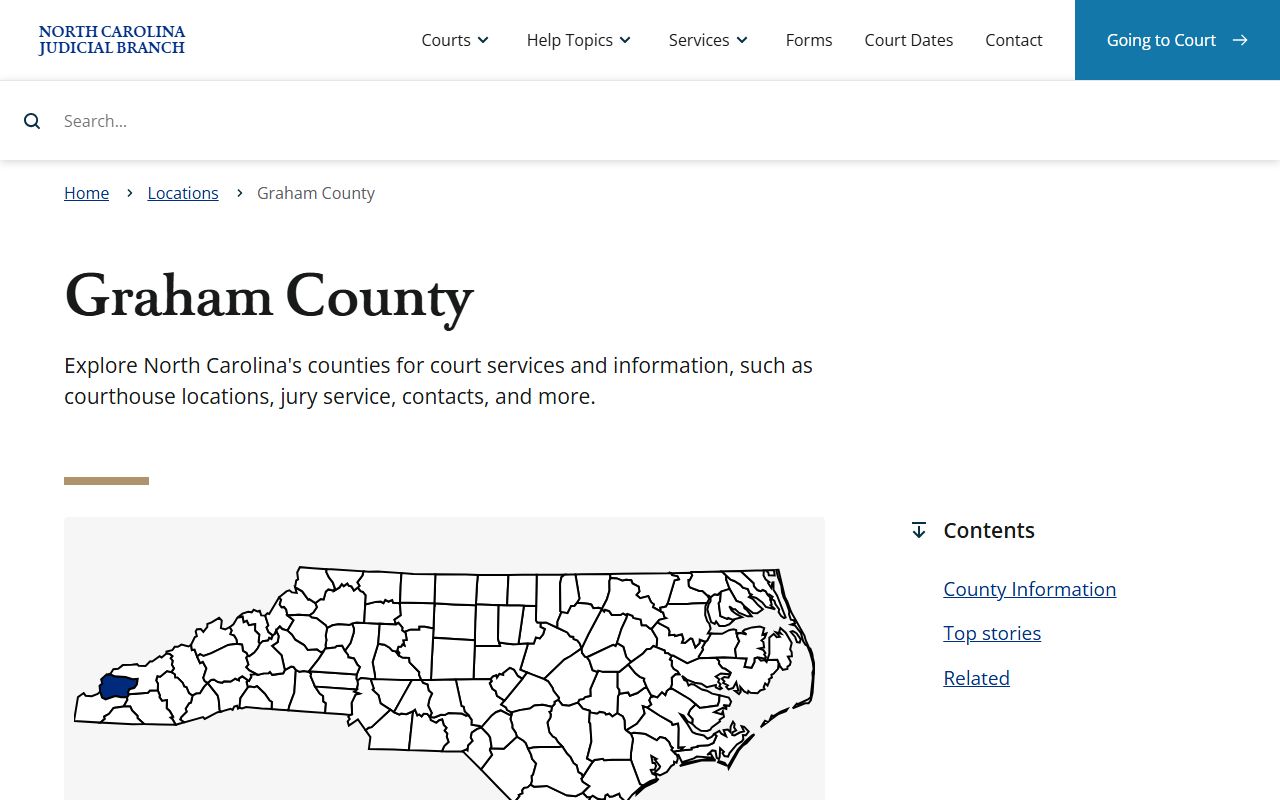
That county court page is the official starting point for court records after a Graham County jail arrest when a case number or hearing date is needed.
Charges Filed After Arrest
A Graham County jail arrest can begin with a warrant, citation, criminal process, or other arrest authority. The court charge record is created through the criminal case process and can differ from the booking allegation. North Carolina law treats returned arrest warrants, returned search warrants, indictments, criminal summons, and nontestimonial identification orders as public court records unless a court seals them. That rule sits inside N.C. Gen. Stat. 132-1.4, which also limits access to criminal investigation records.
| Document | Who Uses It | What It Means After Arrest |
|---|---|---|
| Criminal process or complaint | Law enforcement, magistrate, or prosecutor depending on case path | Starts or supports the criminal accusation that moves into court records. |
| Criminal summons | Court process requiring appearance | Creates a court record without necessarily meaning the person is currently jailed. |
| Indictment | Grand jury and superior-court felony process | Formal felony charging document, public unless sealed. |
| Returned warrant | Court record after execution and return | Shows that a warrant was served or returned to the court, unless sealed. |
Graham County Charge Status
Charge status can change after arrest. A booking charge is the initial allegation recorded by law enforcement or the jail. The prosecutor may proceed on that charge, amend it, reduce it, dismiss it, or present a felony matter for indictment. The North Carolina Judicial Branch criminal-cases materials explain that the State prosecutes criminal cases and that only the prosecutor or a judge can dismiss criminal charges. A court records search should therefore focus on the case status, not just the arrest label.
| Status | What It Means | Record Caution |
|---|---|---|
| Pending | The charge is unresolved and still moving through court. | Future hearings, plea, dismissal, indictment, or trial may change the outcome. |
| Amended | The charge details changed after filing. | Compare the current court record to the booking record. |
| Reduced | The charge was lowered to a lesser offense. | The arrest allegation may sound more serious than the final court charge. |
| Dismissed | The charge ended without conviction. | Dismissal is not the same as automatic expunction. |
| Disposition | The final outcome of a charge. | Use disposition, not arrest, to understand the final court result. |
Bond and Release After Arrest
Bond and release conditions are set by a judicial official, not by a roster website. Under N.C. Gen. Stat. 15A-534, available release conditions include unsecured appearance bond, custody release to a supervising person or organization, secured bond backed by cash, mortgage, or solvent surety, and house arrest with electronic monitoring. Written promise to appear was repealed for determinations on or after December 1, 2025. For Graham County, call the jail for current custody and bond status, call magistrates for immediate release-process questions, and use the official Judicial Branch bondsman service for surety searches.
| Bond or Release Type | How It Works | Graham County Access Note |
|---|---|---|
| Unsecured appearance bond | No upfront payment unless conditions are violated. | Set by a judicial official and confirmed through jail or court contacts. |
| Custody release | Release to a person or organization agreeing to supervise. | May be used when it assures appearance and safety. |
| Secured bond | Requires cash, property, or approved surety. | Use the official bail bondsman search and choose Graham County. |
| House arrest with electronic monitoring | Release with monitoring and secured-bond rules when ordered. | Applies only when ordered by the judicial official. |
| Hold or detainer | Another agency or order may prevent release. | Important when a person is out of county, under safekeeping, or held for another agency. |
Warrants and Returned Records
No official Graham County active warrant search was found. The sheriff website does not publish a warrant list, and unofficial warrant pages should not be treated as court records. A live warrant is different from a returned warrant. North Carolina public-records law makes returned arrest warrants and returned search warrants public court records unless sealed by court order, but it does not require a county to post an active warrant database online.
Use official channels for warrant questions. Call the Graham County Sheriff's Office at (828) 479-3352 for agency routing, the jail at (828) 479-8650 if the warrant may have led to a current booking, magistrates at (828) 479-7019 for immediate judicial-process questions, and the clerk at (828) 479-7000 for returned court records. eCourts may show cases and hearings once the process has been filed, returned, or entered.
Charges vs. Convictions
A Graham County arrest charge is not a conviction. An arrest says that a person was taken into custody or accused through criminal process. A charge says the State is pursuing an accusation in court. A conviction means guilt was established by plea or judgment. Court records after arrest should always be read with the case status and disposition because pending, dismissed, and reduced charges carry different meanings.
| Point | Charge | Conviction |
|---|---|---|
| Stage | Accusation filed or pursued in court | Final finding or admission of guilt |
| Proof | Can begin from probable cause or criminal process | Requires plea, verdict, or judgment |
| Can change? | Yes, it can be amended, reduced, or dismissed | Changes usually require later court action |
| Best field to check | Charge list and status | Disposition and judgment |
Sealed and Expunged Arrest Records
Court records after a jail arrest may become restricted if a court seals a record or grants an expunction. North Carolina expunction eligibility varies by statute and case outcome. The Judicial Branch expunction materials route users to categories such as dismissed charges and certain nonviolent misdemeanors or felonies, while N.C. Gen. Stat. 15A-145.5 covers some nonviolent misdemeanor and felony expunction rules with exclusions. A dismissal does not automatically erase public access.
| Record Treatment | Plain Meaning | Graham County Search Effect |
|---|---|---|
| Sealed | Hidden from ordinary public access by court order. | The portal or clerk may restrict access even when the record exists. |
| Expunged | Removed from public access under an eligible statutory process. | A prior arrest or charge may no longer appear in public court search results. |
| Dismissed but not expunged | The charge ended without conviction, but the record may still be visible. | Check the disposition and seek legal advice about eligibility if record clearing is needed. |
Graham County Court Contacts
The Graham County court contact directory lists Clerk of Superior Court phone (828) 479-7000, magistrates phone (828) 479-7019, clerk email Graham.Clerk@nccourts.org, and District Attorney phone (828) 835-7750 for Graham County court contacts. The District 43 district attorney page lists the main district phone as (828) 349-7210 and names Ashley Hornsby Welch as District Attorney.
The directory is useful when eCourts does not answer a records-access question or when an older case, returned warrant, hearing issue, or magistrate process needs direct court routing.
Important: Court contacts can explain record access and scheduling, but they do not provide legal advice or change release orders by request.
Restricted Graham County Court Records
Some records connected to an arrest may be restricted. Juvenile matters, sealed records, protected witness information, certain mental-health or medical details, and active criminal-investigation materials may not be open in the same way as basic case entries. N.C. Gen. Stat. 132-1.4 is especially important because it makes specific arrest information public while keeping criminal-investigation and intelligence records outside the ordinary public-records category. That is why a sheriff record, a jail record, and a court record can show different levels of detail after the same Graham County arrest.